
Vampire Facial (PRP Microneedling): What It Is & What to Expect
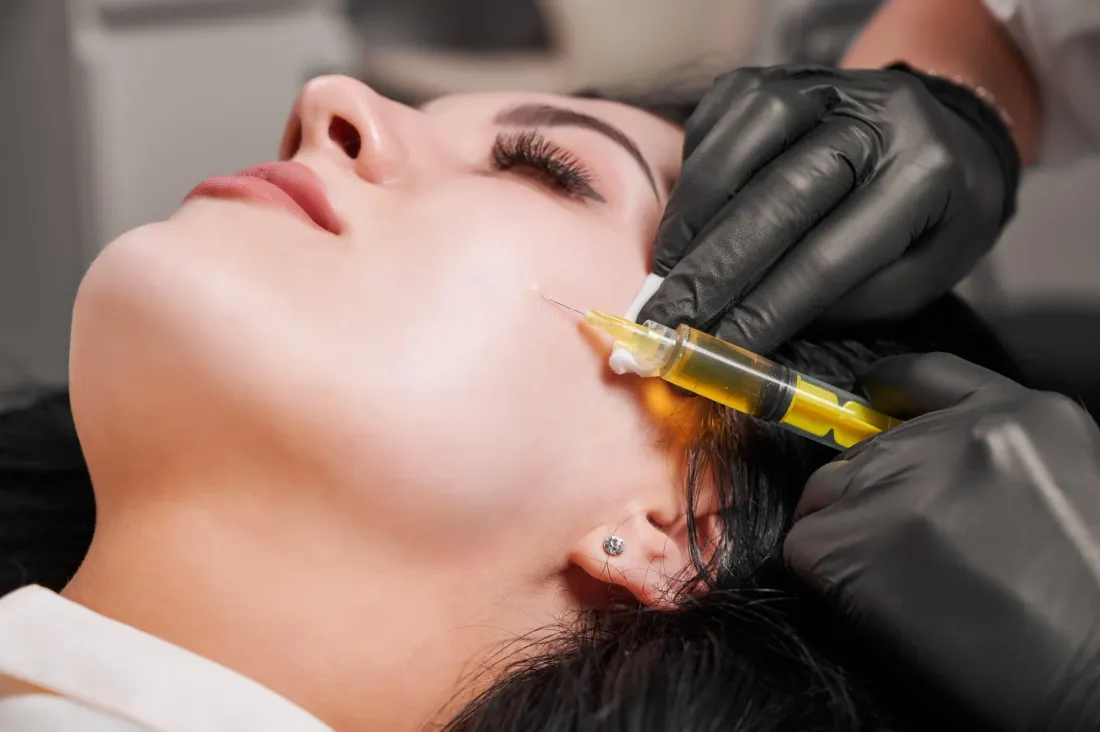
The “vampire facial” has a dramatic name, but the idea behind it is simple and natural: it combines microneedling with your own platelets (PRP) to support smoother, healthier-looking skin. The name comes from the blood draw, not from anything alarming about the treatment. Here’s what it actually involves, what it can realistically do, and who it isn’t for.
What a vampire facial is
A vampire facial is PRP microneedling. It has two parts:
- PRP (platelet-rich plasma): a small sample of your blood is drawn and spun in a centrifuge to concentrate the platelets, the components your body uses for healing and renewal.
- Microneedling: fine needles create tiny channels in the skin, and the concentrated PRP is applied so it can reach past the surface layer.
Neither half is doing the work alone. Microneedling creates a controlled repair response in the skin; the PRP gives that response concentrated material from your own body to work with. Together they support the skin’s natural renewal without introducing a synthetic product. It’s part of our PRP treatments in Brampton.
If you’ve read about a PRP facial and wondered how it differs, the short answer is delivery. A PRP facial can apply platelets topically or by injection; a vampire facial specifically pairs them with microneedling. Our guide to how PRP works for hair and skin covers the underlying process in more detail.
What it can and can’t do
| Concern | Can a vampire facial help? |
|---|---|
| Overall skin texture and roughness | Yes, this is its main use |
| Dullness and a tired-looking complexion | Often, gradually and over a series |
| Enlarged-looking pores | Sometimes, in terms of appearance |
| Fine lines and early crepiness | Sometimes, gradually, it supports skin quality, not volume |
| Some types of textural scarring | Sometimes; Crystal will assess the specific scarring first |
| Deep folds or lost facial volume | No, that’s a dermal filler question |
| Expression lines caused by muscle movement | No, that’s what Botox addresses |
| Active acne, rosacea flares, or an inflamed skin condition | No, treat the condition first |
This is the honest boundary worth understanding before you book. A vampire facial works on skin quality. It doesn’t replace lost volume, it doesn’t stop muscle movement, and it isn’t a tightening procedure. If what’s bothering you is a hollow or a fold rather than the surface of the skin, Crystal will tell you that at consultation rather than sell you a series that won’t address it.
Who it tends to suit
- People focused on texture, tone, and a healthier-looking finish rather than a structural change
- Those who prefer a natural-source approach that works with their own biology
- Anyone building skin quality gradually rather than looking for a single dramatic appointment
- People already having PRP under the eyes or other PRP treatments who want to address the full face
Who it may not be right for
There are times Crystal will recommend waiting, or doing something else instead:
- You’re pregnant or breastfeeding. PRP treatments aren’t offered in either case.
- You have an active skin infection, cold sore, or inflamed breakout in the treatment area. Microneedling across active infection can spread it, this needs to settle first.
- You have a blood or platelet disorder, or a condition affecting healing. PRP depends on your own platelets, so your health history genuinely matters here.
- You’re on blood thinners or regular anti-inflammatories. This doesn’t automatically rule you out, but it must be discussed at consultation.
- You have an event in the next week. Redness for a day or two is normal, and skin can look flushed or slightly rough for a few days afterward. If you’re planning around a date, our wedding prep treatment timeline explains how far ahead to book skin treatments.
- You’ve recently had a chemical peel, laser treatment, or significant sun exposure. The skin needs to be calm before it’s treated.
- You’re expecting one session to change your skin. If a single appointment is all you want to commit to, this probably isn’t the right treatment to start with.
Crystal reviews your medical history before every PRP treatment, and she’ll say directly if the timing or the treatment isn’t right for you.
How many sessions it takes
There’s no fixed number, and anyone promising one before seeing your skin is guessing. PRP microneedling is generally approached as a series of sessions spaced several weeks apart, with the exact plan depending on your skin, your concern, and how it responds along the way. Many people then space out occasional maintenance sessions after the initial series.
The reason is simply how the treatment works. You’re supporting a natural renewal process, not applying a product that shows up immediately. That process takes weeks, and it builds. Individual results vary, and Crystal will set expectations for your skin specifically at consultation rather than quoting a general timeline. For how PRP session planning and pricing work more broadly, see our guide to PRP sessions and cost.
What to expect
- Consultation, Crystal reviews your medical history, assesses your skin, and confirms whether PRP microneedling suits your concern. If something else would serve you better, she’ll say so.
- Blood draw, a small sample, similar to a routine blood test, spun in a centrifuge on site to concentrate the platelets.
- Treatment, numbing first, then microneedling across the treatment area with the PRP applied. Expect roughly 45 to 60 minutes in total, including the draw and numbing time.
- Immediately after, redness similar to a mild sunburn is normal, along with a warm, tight feeling. This typically settles within a day or two, though some people stay pink a little longer.
- The first week, skin can feel slightly rough or dry as it recovers. Crystal provides aftercare covering sun protection, what to avoid, and when you can resume your usual products and makeup.
- Results, develop gradually over weeks as the skin’s renewal process runs its course, and build across a series. Judge it over months, not days.
Our guide to PRP aftercare and how long results last covers the recovery period in more detail, including what to avoid in the first 48 hours.
Because a vampire facial involves a blood draw, handling of your own blood product, and treating the skin’s barrier, it should be performed by someone clinically trained to do it safely. Every treatment at our practice is performed personally by Crystal Simm, RPN (Registered Practical Nurse). If this would be your first appointment with us, what to expect at a first med spa visit covers the consultation and the questions worth asking any injector.
Where it fits alongside other treatments
A vampire facial is a skin-quality treatment, so it tends to sit alongside rather than replace other things. People considering it often also ask about PRP for under-eye circles, a PRP facial without microneedling if their skin doesn’t tolerate needling well, or glutathione for skin brightness as part of a wellness routine. If your concern turns out to be volume rather than texture, what dermal fillers are and how they work is the better starting point.
Crystal will tell you which treatment is doing the most work for your goals, and if a vampire facial isn’t it, she’ll point you somewhere else.
Curious about it?
Book a free consultation with Crystal Simm, RPN, in Brampton, or call (289) 272-3379. She’ll assess your skin honestly and tell you whether a vampire facial fits your goals, or whether something else would get you closer.
Considering prp treatments in Brampton?
Crystal offers a free consultation to talk through your goals and whether this treatment is right for you.
Prefer to talk? Call or text (289) 272-3379.